Double Hump
Double hump questions are “really really high yield” according to nep007 on USMLEForum.com. And without knowing key association, these questions can be confusing. But fear not!!
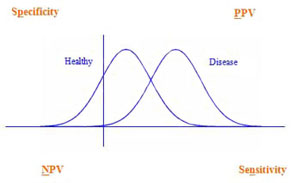
I’ve developed a simple graph that brings it all together. If you can draw a double hump, label four corners, and learn a trick or two, you’ll never have a problem answering a double hump question. (BTW, the content of a double hump question is irrelevant.)
Core concepts of the Double Hump
A typical double hump question will ask, what is the consequence of moving a cut-off point from “x” to “y.” And the key is knowing that true positives (TPs), false positives (FPs), true negatives (TNs), and false negatives (FNs), prevalence, incidence, sensitivity, specificity, positive predictive value (PPV), negative predictive value (NPV), and accuracy are all INTERRELATED
Solving / answering high yield Double Dump questions
I provide 4 Steps to completely understanding the double hump. Step 1 is basically drawing a double hump and by step 3, you’ll have the graph & labels you see on the right.
Step 4 adds key labels and provides intuitive relationships so you’ll know EXACTLY what happens (increases and decreases) to NPV, sensitivity, FN, TN, specificity, PPV, FP, TP when a cut-off point is moved in ANY direction. AND, how prevalence, incidence and accuracy are interlinked too!!
Once a handful of intuitive associations are combined with the graph of Step 4, you’ll be fully prepared to answer questions like:
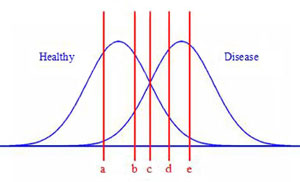
FPs are highest at which cut-off point?
PPV is highest at which cut-off point?
Accuracy is highest at which cut-off point? and
What happens to specificity, sensitivity, PPV, NPV, accuracy, and
prevalence if, for example, the cut-off point is moved from d to e?
The USMLE biostat workbook provides all the associations and detail for the double hump, and additional tricks (simply follow the direction of a hump’s slope to determine ? or ?), commonly-presented word problems with thorough explanations, and more. Buy now!